 Live Chat

Job interview top 8 tips to get results
Congratulations on getting a job interview!
Interviewing for a job you truly want is an exciting opportunity to showcase your strengths, experiences, and potential. But having an interview panel of focus their spotlight on you is enough to make anyone sweat.
From the moment you get the call, chances are you will be thinking about what to do, what to say and what will the job interview questions be?
Earlier we posted about how to land a job interview and how to prepare for your job interview, now here are some tips that will give you an edge over other applicants, and show your potential employer that you’re the best person for the position.
1. Show you’ve researched the company you’re interviewing for
Showing that you have researched the company and the role you are applying for demonstrates that you are genuinely interested in becoming a part of the team. You can say things like, “I’m impressed with your values” or “I saw some of the work you have done on your website – it really aligns well with what I want to do.” If your research uncovers something that aligns closely with the role you’re applying for, be sure to highlight it, along with your personal reflections, to demonstrate genuine enthusiasm and a strong connection to the position.
2. Answer questions with storytelling examples from your experience
Listen and answer. Under the pressure of a job interview, it is often easy to get lost in what the employer is actually asking you. Sometimes, if you are nervous, you might hear them but not really listen to their question.
If a question isn’t clear, don’t hesitate to ask for clarification; it shows thoughtfulness and a desire to give your best answer. Begin by directly addressing the question, then expand with relevant insights or examples. For multi-part questions, tackle each part in order and refer to them clearly so your response stays organised. And when answering, direct your attention primarily to the person who asked the question, as this helps build rapport and shows respect.
The STAR method of answering interview questions is a proven and effective way to respond, to structure your responses and provide a clear and relatable narrative. This can help you illustrate your skills and experiences through storytelling. The acronym STAR stands for:
- Situation: Describe the situation or context within which you performed a task or faced a challenge. This sets the stage for your story. Include short relevant details to help the interviewer understand the background of the story.
- Task: Explain the specific task or challenge you were responsible for in that situation. This should clarify your role and the objectives you aimed to achieve.
- Action: Detail the actions you took to address the task or challenge. Focus on your contributions and avoid using “we” to focus on your individual role. This section should be the most detailed, showcasing your problem-solving skills and initiative.
- Result: Share the outcomes of your actions. Highlight what you achieved, any lessons learned, and how your actions positively impacted the situation. If you can, give clear statistical results to provide concrete evidence of your success.
When using the STAR method, there are a few things you need to do when preparing for an interview:
- Prepare examples: Before the interview, think of several situations from your past experiences that demonstrate your skills and abilities. Use the STAR format to structure these examples.
- Practice your delivery: Rehearse your STAR responses to ensure you can deliver them smoothly during the interview. This will help you stay concise and focused.
- Be relevant: Tailor your examples to the job you are applying for, ensuring they highlight the skills and experiences that are most relevant to the position.
Here is an example of a STAR structured interview response to an interview question:
Interviewer: Give me an example of a time you went above and beyond in your role.
Example STAR response:
S – Situation:
A candidate I was supporting had been unemployed for over a year and was struggling with confidence after multiple rejections. They were highly skilled but had difficulty showing their value in interviews and tailoring their applications effectively for different jobs.
T – Task:
My goal was to help this candidate not only secure employment but also rebuild their self-belief and present themselves in a way that aligned with their strengths and the job market.
A – Action:
I went beyond the standard service by creating a personalised job search plan that included:
- Support to create a tailored resume and cover letter for each application
- Mock interviews with feedback focused on body language, tone, and storytelling
- Connecting them with a mentor in their industry for additional support
- Researching hidden job opportunities and directly reaching out to employers on their behalf
R – Result:
Within six weeks, the candidate secured a full-time role in their field. They later shared that the support they received helped them feel “seen” and capable again. Not only did they thrive in their new role, but they also referred two other job seekers to our service, which led to further successful placements.
3. Show your enthusiasm for this new job
Showing you are excited about the role will make sure the employer knows you will bring fresh energy into the organisation. It also shows that you care about the role and that it is important to you.
Say something like, “I am excited about the role and the opportunity it presents” or “I was excited when I saw this role advertised, as it is such a great fit to my skillset and qualifications.”
There are different ways to show enthusiasm. Tone of voice and body language can speak volumes. Make sure that how you speak and act matches what you say. If you say you are excited, but speak in a low monotone, or while you are slouching back in your chair, this can create the opposite impression. Sitting up straight or slightly leaning forward, and using hand gestures when speaking can help to emphasise your enthusiasm. Speaking in an animated way by slightly smiling as you speak can alter the tone of your voice to sound genuinely excited.
Energy, positivity and enthusiasm are qualities many hiring managers look for, so put your best foot forward.
4. Showcase your confidence
Confidence isn’t about being over-the-top, high energy or outspoken. Confidence is in the way you act, engage and talk.
Don’t be shy to sell yourself, even in a humble way. Remember they do not know anything about you, so sell your skills.
Promote the skills that are aligned to the role. For example, if it is a customer service role, show off skills you have that relate to interacting with people.
If you have little experience, you can draw on any life experience you have or personality attributes that are crucial for the role.
Positive body language is also an essential element of showing your air of confidence. Maintain good posture, engage in direct eye contact with people who ask you a question, and give a firm handshake when appropriate.
5. Build rapport with the interviewer
It is important to build rapport with your interviewers in the job interview. Once you have qualified for an interview, you are already seen as having the qualifications needed for the job on paper. The interview is often more about if you are someone that the interviewers can see themselves working with. Many managers will hire people they believe will fit the organisation’s culture and values.
Showing your personality and enjoying the interview will give the interviewers a strong feeling about what you might be like to work with. Be comfortable, but not so comfortable that you slouch in the chair! You should still always be respectful and polite in the interview.
6. Highlight your responsibility
When discussing previous roles, be sure to highlight the level of responsibility you held. Employers value candidates who take initiative and are trusted to deliver outcomes. Starting your responses with phrases like “I was responsible for…” signals that you were a key contributor and that your role carried weight within the organisation.
Use confident “I” language throughout your interview to clearly articulate your individual contributions and achievements. While being a team player is important, interviews are your opportunity to showcase your unique value. If you’re describing team-based accomplishments, be specific about your role: whether you led a particular aspect of the project, coordinated efforts, or drove results in a specific area. This helps interviewers understand how you operate within a team and the impact you personally made
7. Ask questions about the role and business
The employer will always ask if you have any questions about the position or company at the end of the job interview.
Be prepared with 2 or 3 questions in your head before the job interview. Some examples of questions might be:
- The role is advertised as part-time – how many hours per week will this be?
- How many people are there in the team?
- What does a normal day in the role look like?
- What do you like most about working for this company?
- How do you think my skills align to the role?
If these questions have already been answered by the interviewers earlier in the job interview, you may need to adjust your questions slightly, so it is a good idea to have some back up questions so they don’t have to repeat themselves. This can also make interviewers feel as if you were not listening to their earlier explanation, so keep some other questions in your back pocket.
Questions like these will not only make you look interested in the position, but you can also find out whether the position is a good fit for you.
8. Be polite and well mannered
During interviews, if there are a few people interviewing you, try to give roughly equal attention and eye content with all members of the job interview panel. It can be tempting to answer all of your questions to who you perceive to be the main decision maker, but if you do this, this can seem impolite to other members of the panel and make them feel sidelined. Keep them on side by speaking directly to all the different panellists at different times.
At the end of the job interview you can say something like: “Thank you for your time today and I’m looking forward to hearing from you.”
This will show that you are well mannered and courteous and genuinely interested in getting the position.
Position yourself as the ideal person for the role
It is often hard to even land a job interview, and you would not be given the time if they did not see you as a strong candidate.
Understanding what the employer is looking for and proving that you are their solution is key. Selling that you are a good fit for the company, and the right person to undertake the role is the most important thing to remember.
As always, if you do not land the job – shake it off! Every interview you have is a great opportunity to practice selling yourself for the dream job you will eventually get. Get back out there and keep trying.
Connect to CVGT Employment
At CVGT Employment, we support businesses to achieve inclusive employment through a range of tailored services. Whether you’re looking to hire someone with a disability, support a young job seeker, or explore apprenticeships and traineeships, we can help you find the right candidate for your team.
We also offer expert advice to make inclusive hiring even more accessible.
Contact us on 132 848 or visit cvgt.com.au to learn how we can help you build a more inclusive workplace.
Explore more helpful articles and success stories from CVGT Employment.

Inclusive employment- the future for Australian businesses
Forward-thinking Australian businesses aren’t just talking about diversity. They’re embedding inclusion into every layer of their operations, and they’re seeing the results: stronger teams, smarter decisions and deeper connections with their communities. What inclusive employment really means Inclusive employment goes beyond hiring someone with a disability. It means creating workplaces where people of all backgrounds,…

Building skills, building stability
When Rebecca Hodge, a single mother from Albury, found herself getting only ten hours of work a week as a room attendant, she knew something had to change. She joined CVGT Employment’s Workforce Australia program for support to boost her hours and create a more secure future. Exploring opportunities to grow At her first appointment,…

From looking for work to creating opportunities for others
Finding work after losing a job can be daunting, especially when navigating a new country and unfamiliar systems. For Innocent Ntumba Tshilombo, what began as a challenging period of unemployment became the start of a new career chapter- one that would see him become an Employment Consultant and purchase his first home in Australia. After…
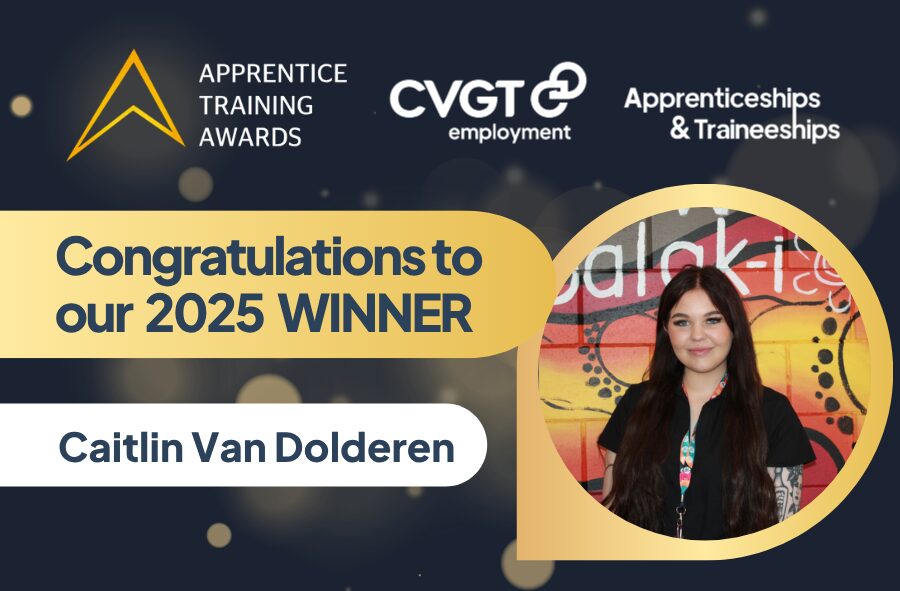
CVGT Employment Trainee celebrates two major wins at the 2025 Apprentice Training Awards
The winners of the 2025 Apprentice Training Awards were announced last night at a spectacular ceremony at Melbourne Town Hall, celebrating the achievements of Victoria’s apprentices, trainees, and Group Training Organisations (GTOs). Hosted by the Apprenticeship Employment Network (AEN) and Global Apprenticeship Network (GAN) Australia, these awards recognise excellence in the group training sector and…

International Day of People with Disability (IDPwD) – Wednesday, 3 December 2025
International Day of People with Disability (IDPwD) is on Wednesday, 3 December 2025. Table of ContentsWhat is IDPwD?This year’s IDPwD themeWhy does CVGT Employment celebrate IDPwD?Our services support people with disability to find meaningful workWe are proud to be an inclusive employerNot every disability is visible, some are hiddenHow we’re celebrating IDPwD 2025 in our…

Connecting with your community in 2025
Thank you for being part of our journey throughout 2025. Whether you’re a team member, partner, employer, community organisation, participant, supplier or supporter, your contributions, collaboration and commitment have helped shape a year full of progress, connection and impact. We’re proud of what we’ve achieved together and deeply grateful for the role our community has…